
Maturity modelling
The growth of home-based working and virtual offices has been advanced by some powerful driving factors:
Many are likely to have some familiarity with the concept of the maturity model. However, for those that are not or that require a refresher, a maturity model is a business tool that is frequently used to assess items such as people and culture, processes and structures, and objects and technology.
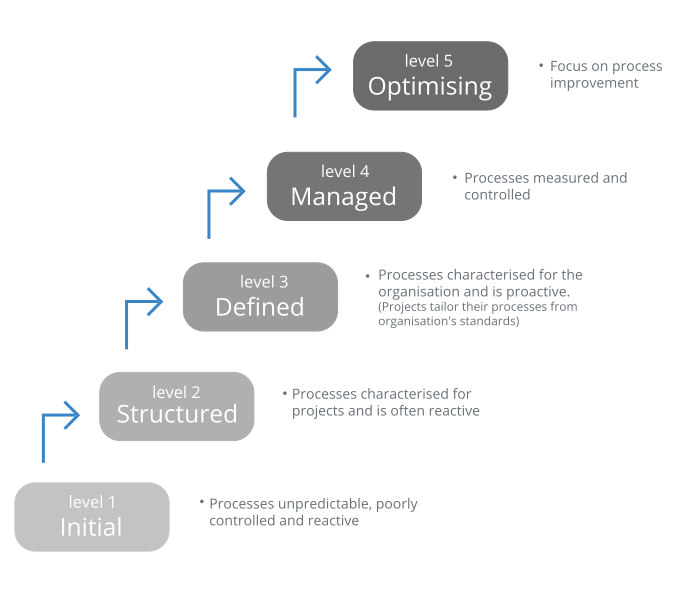
One way of applying the model is the bottom-up approach. In this approach, distinct characteristics of each level are determined and clustered in ascending steps to map a general view of the evolved maturity of the subject in question.
A typical bottom up maturity model is shown below:
Download this White Paper
Frustrations aside, working from home is not without its risks. Besides the obvious HR issues of whether homeworkers are actually working for you, moonlighting for personal gain, or selling you down the river to the competition, there are significant IT security issues.
The penetration of the business network by malware should be of concern to all .There is also a big issue for businesses whose stock in trade is IP, in the threat of theft and loss of commercial advantage.
Many attach significant value to CRM, and not just because it may provide competitors with the opportunity to exploit your customer base, something you have likely spent years developing.
Security breaches relating to customer data have an added dimension in that they may represent compliance failure under ICO/DPA guidelines and requirements, inviting reputational damage, financial penalty and, if recent parliamentary recommendations are implemented, custodial sentences.
In this guide, we discuss the key considerations for businesses seeking to maximise the benefits of home working while ensuring the interests of the organisation are not compromised.

Enabling seamless, fully productive home working
When evaluating the advantages of home working, some of the primary considerations are centred on the question of productivity. Today’s cloud technologies provide a solid platform for seamless and fully productive home working, allowing businesses to fully exploit the benefits.
Access to files and resources
24/7/365 access to files, databases and any technology resource available to the rest of the business.
- Enables anytime working patterns to suit the requirements of individual
- Allows hours of work flexibility to meet business needs such as delivery deadlines
- Accommodates requirements for time shift for globally dispersed workers
Collaboration
Enables collaborative working with customers, co-workers and delivery partners using tools such as:
- Outlook and its extended groupware features
- SharePoint and other Microsoft technologies such as Skype for Business (see below)
- Social enterprise software tools such as the eXo platform
- Any other appropriate web collaboration applications
Communication
Written
Fully supports the exchange of written communication. Some provide messaging, voice and video.
- Instant Messaging, voice and video calling with Skype for Business
Voice
Fully enabled cloud PBXs offer flexibility at reduced cost over conventional ISDN and on-premise PBX-based systems.
- Familiar handset at home means staff and the business benefit from an ‘as if in the office’ feel
- Support for mobile phones to be integrated as system extensions
- Integrated ‘softphones’ (a software application that provides telephony on a computing device)
Dealing with the downside risk of home working
The cloud mitigates the downside risks of homeworking from the HR perspective and by providing the right security to protect against security breaches.
HR
- Performance assessment through measurement and tracking of factors such as, login/out time, calls and web browsing, file access
- Audit trail of activity including document access, emailing, printing etc.
Security
- Securing network against penetration
- Protecting data against theft and misuse by preventing data being taken offline or only allowing it in controlled fashion
- Defending web and email channels against infection by malware
- Protecting staff against Internet nasties through porn filtering and screening for offensive emails or those with malware attachments
Cloud options for productive and secure home working
The cloud delivers applications and data over business-class broadband internet connections, enabling businesses that need access to standard productivity and communications tools to ‘consume’ IT as a service. There are a number of options when choosing the right cloud solution for your business.
Microbusinesses (1-9 staff)
Office 365
1- 9 person microbusinesses may not need anything other than Office 365 deployed across the business with other key cloud applications for CRM/sales, accounting and project management. May also be a low-cost, least complex option for the foundation phase of start-ups and for the ongoing requirement of more established smaller, no-brick entrepreneurial ventures.
Risk and micro businesses – a word of warning
Micro businesses are probably less averse to risk. Having all your data in multiple cloud locations and accessible from anywhere, means you absolutely and implicitly trust your staff to ensure that every device they use is secure if they are downloading data. If they are uncertain about device security they should not download any data.
Having said that, it is very difficult to enforce and impractical because employees do not have the skills and neither the time or the inclination. The firm’s data will probably end up distributed over multiple devices in multiple locations, and the company will have no idea where it is.
Growing businesses (10 -100 staff)
Hosted Desktop
Secured, shared cloud platforms enable economy of scale through infrastructure sharing and in most use cases this is almost certainly the most cost-effective and best value cloud solution.
A Desktop-as-a-Service (DaaS) solution provides core infrastructure such as firewalls, storage systems and servers. These are multi-tenanted, sharing the resources amongst multiple companies, and reducing costs through economy of scale.
The systems are designed in such a way as to maintain security. Even for businesses regulated by the FCA or requiring ISO27001 security, the best iterations of these systems easily tick all the boxes. Data can be centrally maintained and secured whilst any data that needs to be distributed offline can be distributed in a secure manner.
DaaS has the ability to support unique software such as proprietary third-party databases and generally meet a firm’s requirements in full. It may not, however, be quite as flexible or capable as a private cloud solution.
Private cloud
A private cloud is a secured platform and by definition it does not share resources between multiple businesses. It is expressly for the use of a single business and provides the ultimate guarantees of security.
Companies choosing a fully customised private cloud solution are able to choose the system options that suit them best at every layer: hardware, software, network, security, administration and management.
Every specific requirement can be tailored in to the solution. This may include heightening user experience, opening administration up to internal IT teams, and tailoring security to specific requirements.
Summary
Risk has been an obstacle that has prevented many companies from embracing home working. However, today’s cloud-based technologies not only provide the seamless productivity that lets home workers be as effective, and achieve the same levels of performance as office based staff; now, cloud-based systems also mitigate the downside risks associated with home working.
Why is HTL Support a preferred technology support provider
HTL provides a range of services to support the use of technology in today’s businesses. Whether it is infrastructure and user support, internet connectivity or voice communications, we provide the high degree of personalised service.
We are very proud to be able to say that we offer impartial advice because we are independent of suppliers, vendors and manufacturers. Ultimately this enables clients to obtain more value from business technology.
The cloud enables businesses to maximise the benefits of home working while enabling the associated risks to be mitigated.
About HTL Support
HTL Support was initially founded in 2009 by Managing Director Justin Dean, to provide specialist IT support and IT consultancy services to financial services sector clients. Since its launch, HTL has rapidly evolved to offer a full range of cutting-edge, integrated and flexible products and services to a worldwide client base across all industries. Our experience and professionalism has been endorsed both by our clients and by many of the world’s leading hardware and software manufacturers.
All companies need to know that their IT support provider is not going to let them down when it comes to important projects. We will always find the right solution and are equally happy either functioning as project managers for your internal IT department or providing an experienced team to work under your own IT Director or project leader.
References and further reading
Serviced Cloud
Microsoft Office 365 Solutions
https://www.htl.london/cloud-solutions/microsoft-office-365
Serviced Cloud
Hosted Desktop Solutions
https://www.htl.london/cloud-solutions/hosted-desktop